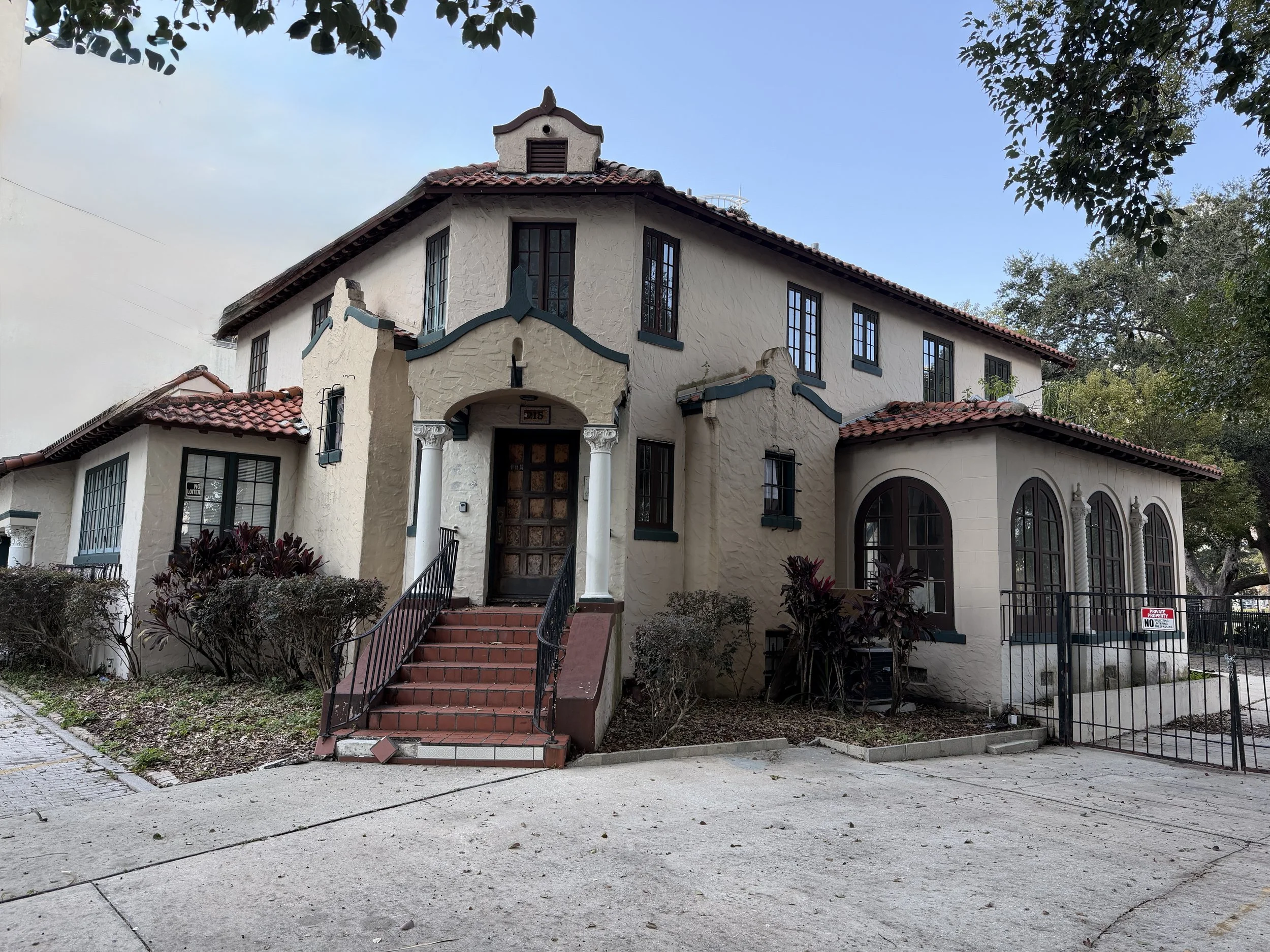
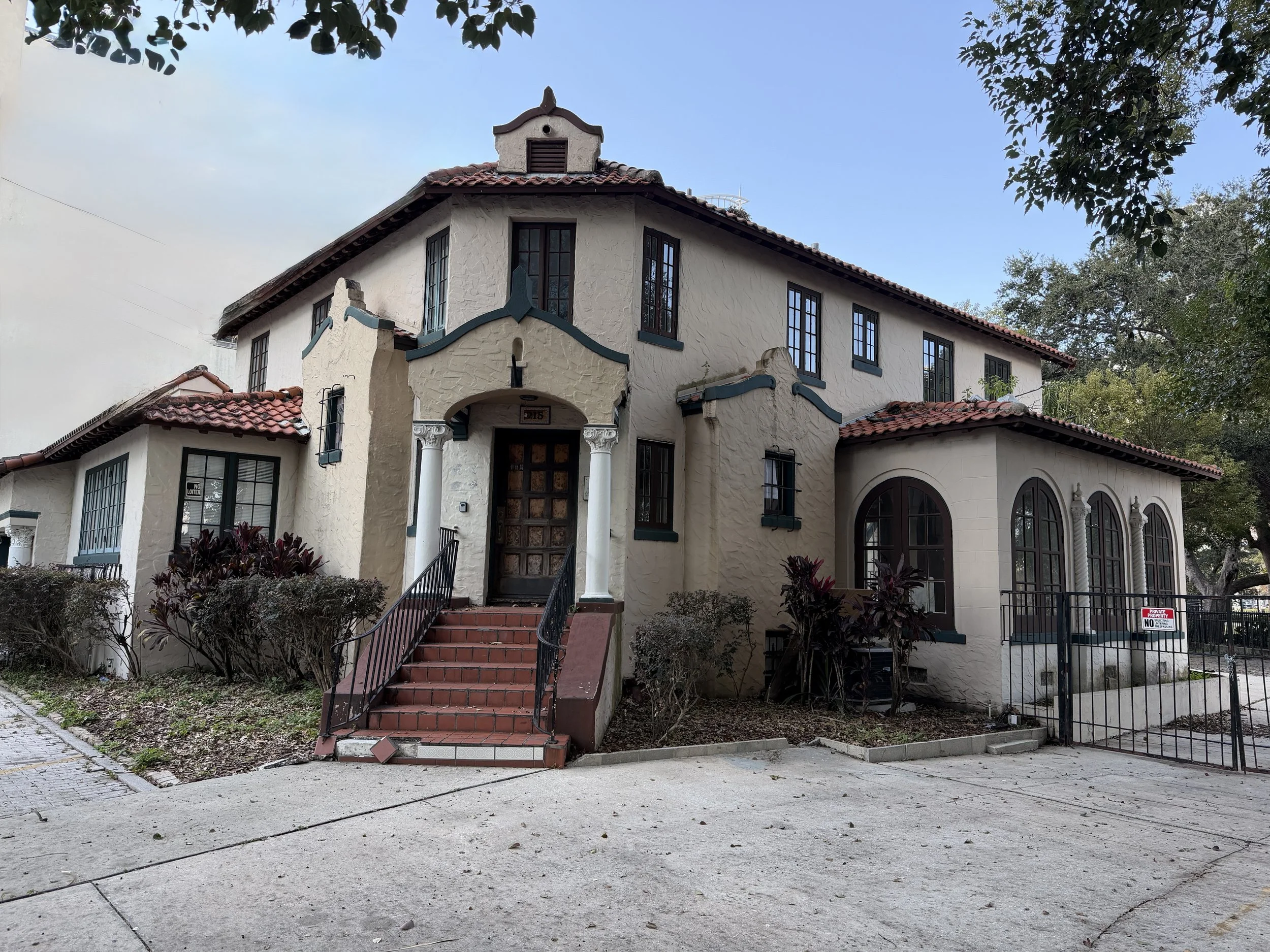
Orange Preservation Trust, OPT, has nominated the Lubbe House located at 215 E Central Blvd in downtown Orlando to the City of Orlando’s Landmark list. The city has acquired the property at the southwest corner of Lake Eola Park and is planning a gateway entrance. The Lubbe House, (pictured), was constructed on the site in 1930 and sites near the corner. According to research done by Dr. Tana Porter, PhD History, the undeveloped property has been owned by several notable Orlandoans, most notably Jacob Summerlin and Hobart Sperry. Prior to development of the area much of the land was later sold to James Thornton. It was Thornton, who is associated with what is now enjoyed as Thornton Park, that subdivided the area and sold the parcel to the Lubbes to build their home.
The newspaper, Orlando Evening Star, reported the sale including Lubbe’s announcement that he planned to build a residence on Central Avenue overlooking Lake Eola, a house that “would be in keeping with the Florida setting but would be something different in tropical architecture.” The newspaper followed its January twenty-third- announcement of the sale with a comment two days later extolling the beauties of the property, calling it “one of the best purchases that have been made in the history of Orlando. This is one of the most desirable locations in the city. Orlando’s growth in commercial importance, in domestic enjoyment and in physical beautification, will make the possibilities of the Lubbe location incomparable.”
The Lubbes took possession of their completed house in mid-November, 1930. On November 19, 1930, the Evening Star again described “one of the outstanding homes of Orlando,” and its “Beautiful grounds with stately trees and artistic landscaping,” The “rich tint” of the stucco exterior came from Chicago, and the “hurricane proof tiles, interlocking and overlapping to prevent being torn off by storm,” came from Holland. “Solar heaters” and a new kind of a gas furnace came from California. “Bird baths, unique urns, and garden furnishings” decorated the lawns. Its Moorish architectural style framed by palm trees, the house fronted on Lake Eola. It had three large bedrooms and two tile bathrooms, two sun porches and a balcony overlooking Eola Park and its rose garden. Most of the furnishings were custom built for the house. Needless to say this was meant as a building of place and permanence. The Lubbe House is the last remaining home that was built on Lake Eola.
The city’s goal of place making benefits both residents and visitors alike by improving the quality of life and economic interests of the community. Landmarking the Lubbe House will work well with the city’s initiatives by recognizing the historic past and established sense of place that creates a unique destination and also bridges our past with our future as the surrounding park is enhanced. Landmarking the Lubbe House does not prevent the city from changing the use of the building, modifying the building with additions to increase usable space or minor adjustments to its position. Preservation and development are not mutually exclusive, there are many examples globally that with creative design have produced celebrated spaces.
Over the past year Commissioner Sheehan had been going to speaking appearances at neighborhood associations with assurances from Mayor Dyer that the Lubbe House was to be included in redevelopment of the park. However, to her surprise and anger she has since been advised that the house is to be deleted from plans. In her discussions with city planners she has been told that the house needs to be demolished due to the high cost of restoration. When asked for substantiation on their claim they were unable to provide any. She also asked why there has not been any public inclusion in the design concept. During community events sponsored by the Downtown Development Board, DDB, discussing 5 major initiatives downtown, when asked about the inclusion of the Lubbe House, their reply was ‘there is no final decision’. Actual public media of a suggested design entry gateway, the Lubbe House is clearly in the background.
The Historic Preservation Board will hear the landmark request possibly in March, an update will be announced. Public presence at the meeting would be invaluable. For those unable able to attend, letters in support are equally helpful. If the request for landmarking is approved by HPB it will be sent to City council for recommendation or denial at an expedited reading at the end of February. Those who have been in Orlando for quite a while may remember the McCrory’s Five and Dime on Orange Avenue request for historic protection. Under pressure from a developer the request was denied by Mayor Dyer and the city council and demolition began immediately after the meeting and continued all the through the night leaving a pile of rubble the next day. The Mayor and Council’s action along with the immediate demolition denied any due process and opportunity for the public to appeal their decision. It has happened before and it can happen again.
OPT is asking for support in approving this Landmark designation and keeping the Lubbe House in any final park plans. We ask any organizations or by individual interested persons to send letters/emails indicating your support. Communications can be sent to the City of Orlando Preservation office as well as the Mayor and commissioners at the following email addresses. In reference to the landmark request, it can be identified as either 215 E Central Blvd, Lubbe House or HPB2025-10297
Mayor Buddy Dyer buddy.dyer@orlando.gov
Comm Tom Keen Dist 1 tom.keen@orlando.gov
Comm Tony Ortiz Dist 2 tony.ortiz@orlando.gov
Comm Roger Chapin Dist 3 roger.chapin@orlando.gov
Comm Patty Sheehan Dist 4 patty.sheehan@orlando.gov
Comm Shan Rose Dist 5 district5@orlando.gov
Comm Bakari Burns Dist 6 bakari.burns@orlando.gov
Jennifer Fritz-Hunter Orlando Historic Preservation Office jennifer.fritz-hunter@orlando.gov